01 — The inspiration
Borrowed from the brain
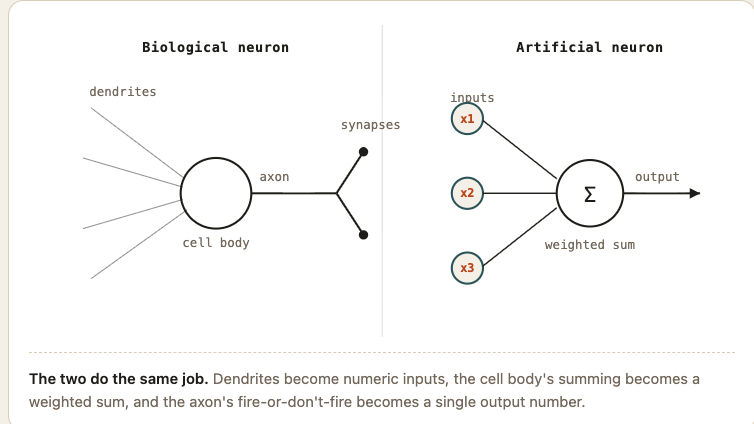
Your brain is built from cells called neurons. Each one collects signals from its neighbors, and if those signals add up to enough, it fires a signal of its own down a long fiber to the next cell. Nothing about a single neuron is smart — the intelligence comes from billions of them, wired together.
An artificial neuron is a deliberately crude copy of that idea, built entirely from numbers. It keeps the shape of the original — gather signals, combine them, decide whether to pass something on — and throws away everything else.Biological neurondendritescell bodyaxonsynapsesArtificial neuroninputsx1x2x3?weighted sumoutputThe two do the same job. Dendrites become numeric inputs, the cell body’s summing becomes a weighted sum, and the axon’s fire-or-don’t-fire becomes a single output number.
02 — The building block
One neuron, deciding something small
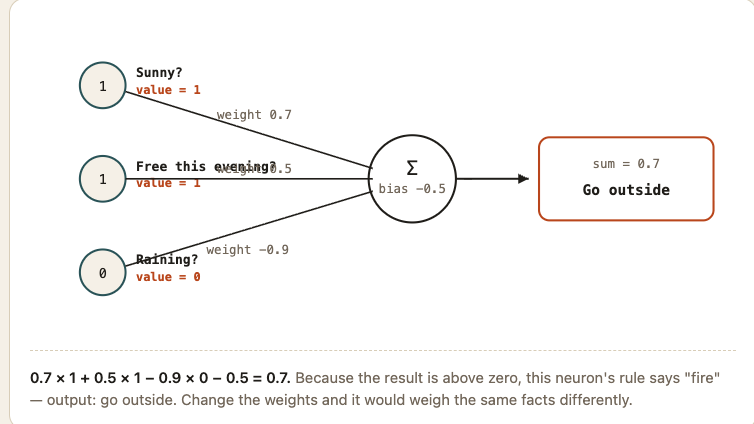
A single artificial neuron does three things: it multiplies each input by a weight (how much that input matters), adds a bias (a built-in nudge), and passes the result through a rule that turns the sum into an output. Here’s one deciding whether to go outside.1Sunny?value = 11Free this evening?value = 10Raining?value = 0weight 0.7weight 0.5weight ?0.9?bias ?0.5sum = 0.7Go outside0.7 × 1 + 0.5 × 1 ? 0.9 × 0 ? 0.5 = 0.7. Because the result is above zero, this neuron’s rule says “fire” — output: go outside. Change the weights and it would weigh the same facts differently.
The weights and the bias are the only things a network actually contains. Everything you’ve heard about a network “knowing” something really means: its weights happen to be set to useful values.
03 — The network
Wiring thousands of them together
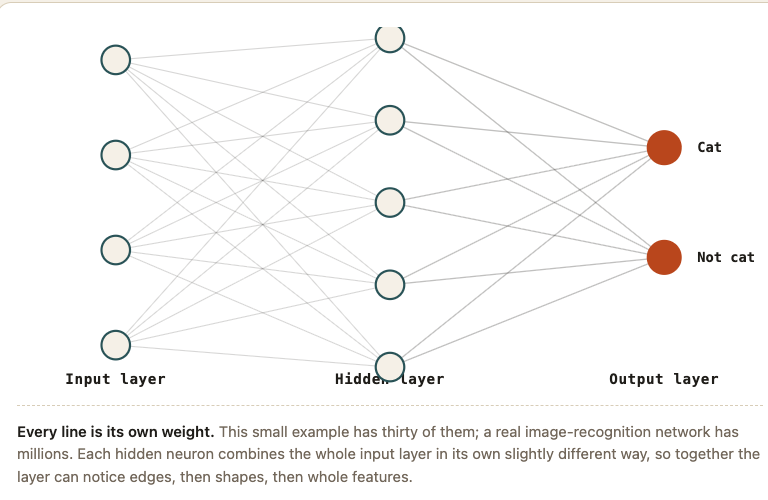
One neuron can only weigh a few facts. Real problems — a photo, a sentence, a sound clip — need many neurons arranged in layers: an input layer that takes in raw data, one or more hidden layers that combine it in increasingly abstract ways, and an output layer that gives the final answer.Input layerHidden layerOutput layerCatNot catEvery line is its own weight. This small example has thirty of them; a real image-recognition network has millions. Each hidden neuron combines the whole input layer in its own slightly different way, so together the layer can notice edges, then shapes, then whole features.
04 — Learning
Where do the weights come from?
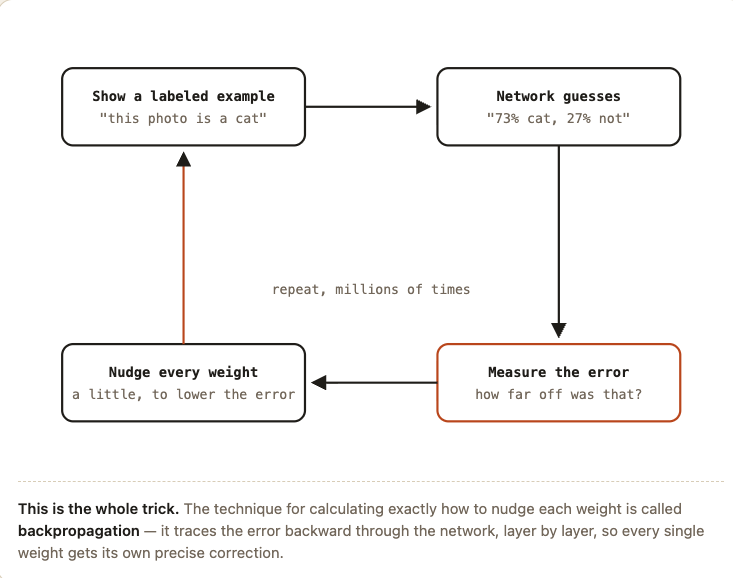
Nobody sets millions of weights by hand. Instead, the network starts with random ones — it guesses badly on purpose — and then trains: it repeats a short loop, thousands or millions of times, each time getting slightly less wrong.Show a labeled example”this photo is a cat”Network guesses”73% cat, 27% not”Measure the errorhow far off was that?Nudge every weighta little, to lower the errorrepeat, millions of timesThis is the whole trick. The technique for calculating exactly how to nudge each weight is called backpropagation — it traces the error backward through the network, layer by layer, so every single weight gets its own precise correction.
Given enough labeled examples and enough loops, the weights settle into values that make good guesses — not because the network understands cats, but because those particular numbers happen to separate “cat” patterns from everything else.
05 — Putting it together
A trained network, at work
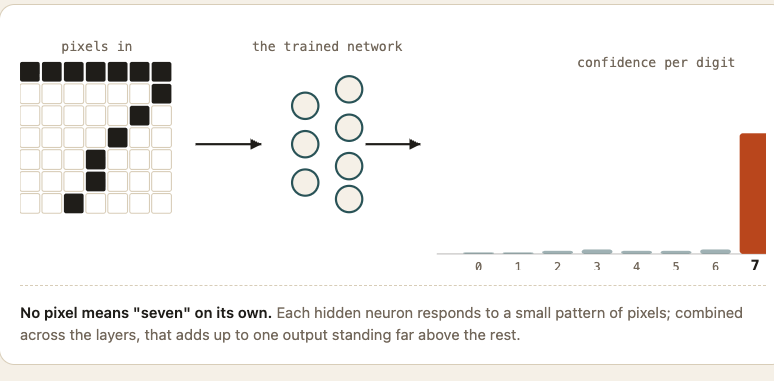
Once training is done, using the network is fast and simple: one forward pass through the layers, no more adjusting. Here’s a (greatly simplified) network reading a handwritten digit.pixels inthe trained networkconfidence per digit0123456789No pixel means “seven” on its own. Each hidden neuron responds to a small pattern of pixels; combined across the layers, that adds up to one output standing far above the rest.
06 — Keeping it honest
What this picture leaves out
Real networks are this idea taken to extremes rather than something fundamentally different. A large language model has many layers and billions of weights instead of thirty; images pass through neurons arranged to scan for local patterns rather than see every pixel at once; and training needs carefully chosen examples, because a network only ever gets as good as what it was shown — bias in the examples becomes bias in the weights.
It’s also worth being plain about what a network is not doing. It has no model of the world, no goals, and no awareness of what it’s looking at — it is a fixed mathematical function, shaped by training, that turns one set of numbers into another. That function can be extraordinarily useful without there being anyone “home” inside it.
A short glossary
NeuronA unit that multiplies its inputs by weights, adds a bias, and passes the sum through an activation rule.WeightA number that scales how much one input matters to a neuron. Training is mostly the process of adjusting these.BiasAn extra number added to the sum, letting a neuron fire more or less easily regardless of its inputs.Activation functionThe rule that turns a neuron’s sum into its output — often something like “pass it through if positive, otherwise send near-zero.”LayerA group of neurons that all take input from the same previous group and hand their output to the same next group.BackpropagationThe method used during training to work out exactly how much to adjust each weight, based on how wrong the final guess was.